
For many consumers the contact centre is the only human touchpoint they have with their energy provider. That one interaction—whether smooth or stressful—can define their view of the entire brand.
Research from Engage Customer, conducted with Davies Hickman, reveals that across all sectors, 72% of UK consumers say that the way they are treated in contact centres influences long-term loyalty. In sectors like energy—where the core product is essential but largely invisible—the quality of service is even more critical.
While platforms like Trustpilot offer real-time sentiment snapshots, broader research and sector trends offer a more holistic view. This blog draws from those sources to highlight what energy providers are getting right, where they can improve, and how agent quality, tech, and training all play a role.
Section 1: Common complaints
Despite investment in digital tools, many energy contact centres still face long-standing issues. From the Engage Customer study and customer feedback across review platforms:
• Long wait times and repetition of information top the list of frustrations.
• Customers often speak to multiple agents before getting help.
• Limited hours make it hard to call after work or on weekends.
Outsourcing also draws criticism:
• Language barriers or unfamiliarity with local policy.
• Rigid scripts that leave little room for empathy.
As one customer put it “I spoke to four different people and still didn’t get my issue resolved.”
Section 2: The people factor: agent quality matters
While systems and tools are important, the person on the other end of the call is often the deciding factor in whether an experience feels frustrating or supportive.
Agent quality can vary significantly based on:
• Outsourcing vs. In-House Teams: In-house agents tend to have more brand-specific training and quicker access to internal teams. Outsourced agents may lack this context, limiting their ability to resolve complex issues.
• Training and Onboarding: Companies that invest in ongoing, scenario-based training see better outcomes. According to a 2023 report by the International Customer Management Institute (ICMI), this approach leads to a 23% increase in first-call resolution rates and a 17% boost in customer satisfaction scores.
• Script Flexibility: Agents who can deviate from rigid scripts and respond with empathy are more effective at diffusing tension and solving problems.
• Empowerment: Even the best-trained agents struggle without access to decision-making power or internal systems. The ability to take action—or at least offer a smooth handoff—is key.
Section 3: Shining moments
When energy contact centres get it right, they create memorable, positive experiences. According to our research of Trustpilot reviews:
• Nearly half of all positive feedback across sectors is about individual agents, not systems.
• Terms like “empathetic” and “took ownership” appear frequently in positive comments.
Customers appreciate:
• Agents who listen without rushing.
• Reps who follow through instead of handing off.
• Clear, patient communication, even during stressful moments like outages or billing issues.
One customer said “It wasn’t just that they fixed the issue—it was how they made me feel heard.”
Section 4: What Trustpilot tells us
To gain a clearer picture of how energy customers experience contact centres in practice, we coded 600 Trustpilot reviews—100 comments each for six major UK energy providers. The data revealed just how central customer service is to people’s perception of their energy supplier. On average, 63% of all verbatim reviews mentioned customer service, with British Gas (80%) and EDF (76%) topping the list. This underscores just how defining a single call can be to a customer’s overall sentiment.
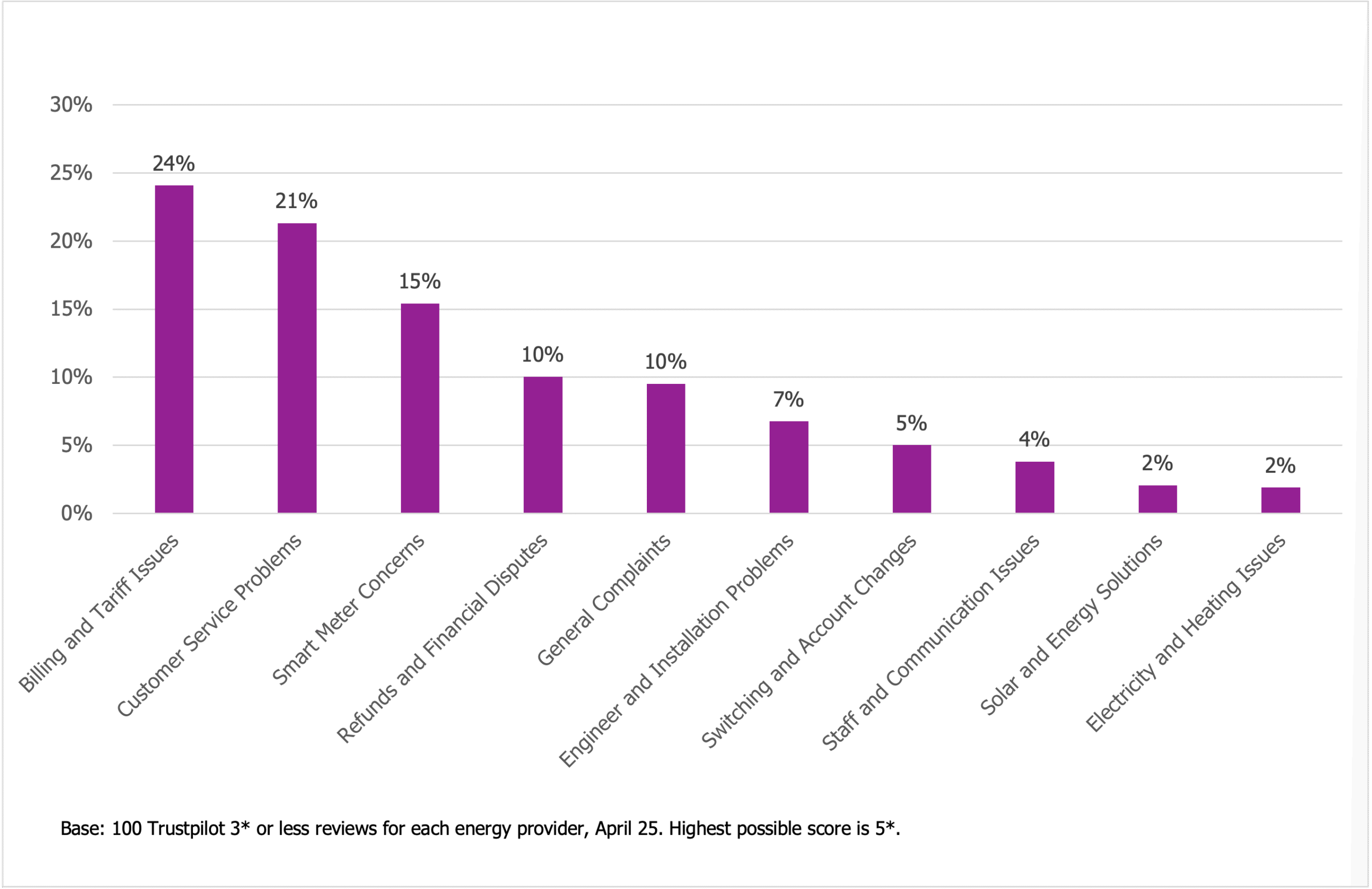
What was the purpose of the contact with the home energy providers? The most common was billing and tariff isues, followed by customer service problems and then smart meter issues.
Percentage of 3 star or lower reviews – purpose of customer contact in online review comment
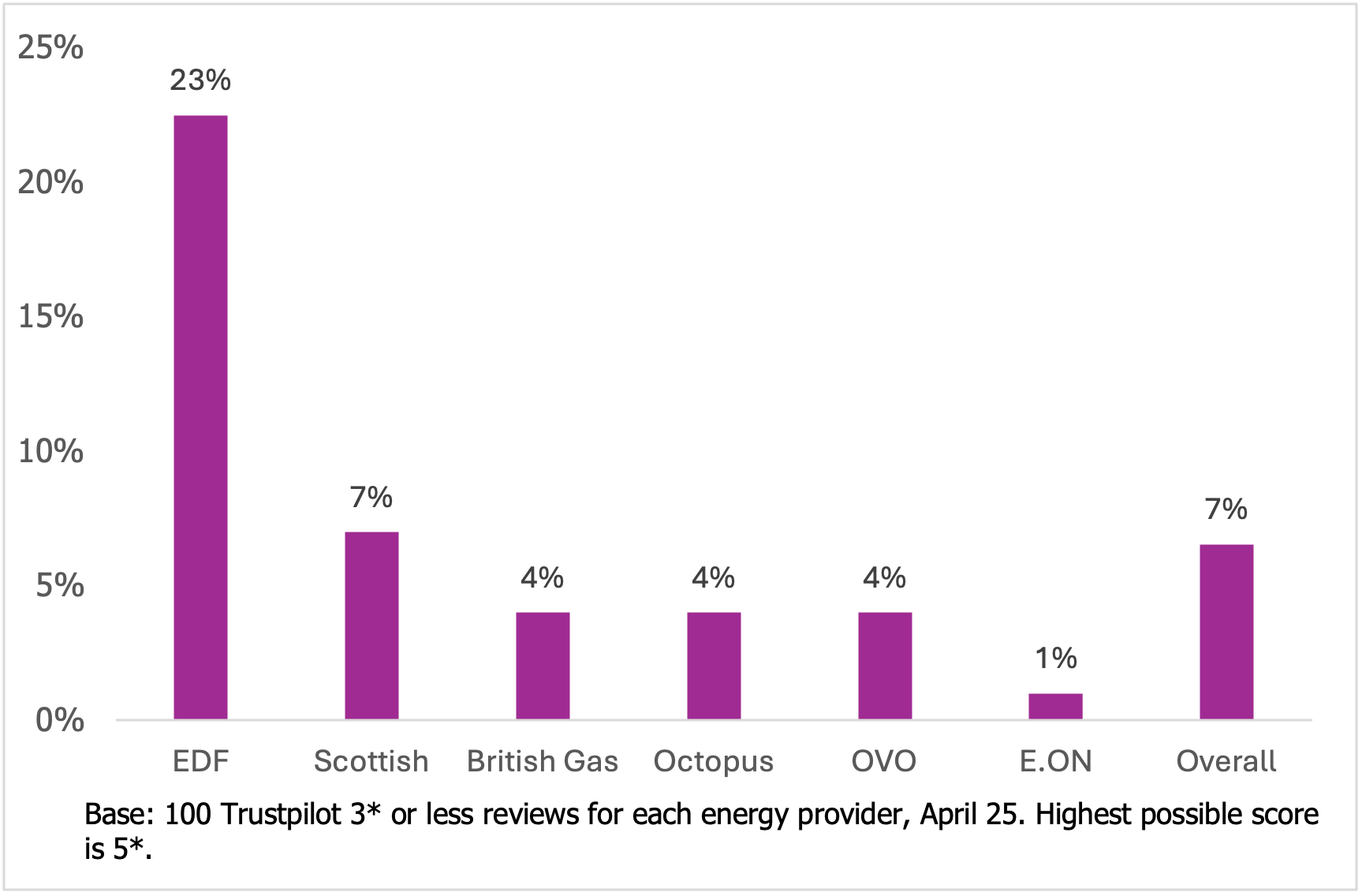
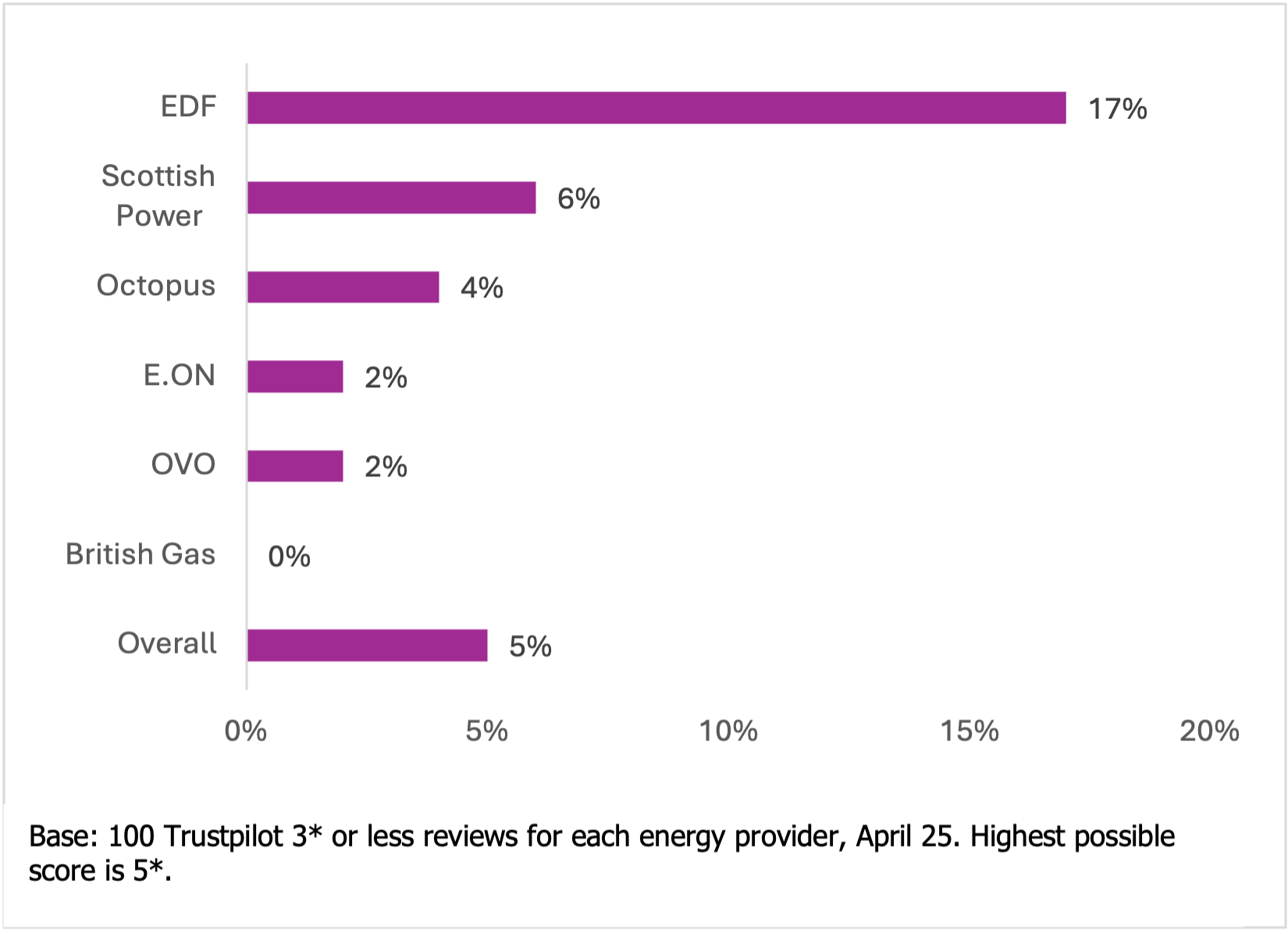
But mentioning service in the review is one thing—what about effectiveness in dealing with the customer issue? The findings paint a concerning picture. Across all reviews, only 7% of verbatims described the agent as helpful, and just 5% said their issue was actually resolved. EDF stood out positively, with 23% of their reviewers praising agent helpfulness in their verbatims, and 17% saying their issue was resolved – a significantly higher rate than any other provider.
Percentage of 3 star or lower reviews mentioning agent helpfulness in online review comment
Percentage of 3 star or lower reviews mentioning their issue as being resolved in online review comment
Successful agent performance is not just about friendliness—it’s about giving agents the tools, training, and authority to truly solve problems. Without that, even the most patient call becomes a dead end.
Section 5: The tech factor
Technology in contact centres can enhance—or hinder—the customer journey.
Helpful tech includes:
- Clear IVR (Interactive Voice Response) menus.
- Callback options that save customers from holding.
- Seamless transitions between digital and human support.
Frustrating tech includes:
- Overly complex menu trees.
- System downtime that paralyses both staff and customers.
According to Zendesk’s 2025 report, 80% of customer service organisations are expected to use AI tools to improve agent productivity and response times. The key is not to replace humans, but to empower them. Meanwhile, a recent industry review by Master of Code found that 52% of contact centres have already invested in conversational AI, and 44% plan to do so.
In practice, AI in energy contact centres is already being used to:
- Power chatbots that handle routine queries like meter readings and payment dates.
- Offer real-time support to agents, surfacing relevant help articles or customer history.
- Analyse sentiment in conversations to help managers coach teams more effectively.
- Spot trending issues before they turn into full-blown complaints.
But AI has its limits.
Customers often express frustration when chatbots block access to human help, or when automated menus can’t understand their issue. Energy problems—especially billing disputes or emergency outages—often require empathy and flexibility that only people can provide.
That’s why the future isn’t AI instead of people—it’s AI alongside people. Used responsibly, AI should make human agents more efficient, more informed, and more available when it matters most.
Section 6: How to improve
Energy companies can significantly improve customer experience by rethinking the structure and support systems behind their contact centres. And AI, when used strategically, can help deliver on many of these goals:
- Reduce internal silos:
AI can analyse large volumes of customer interactions to identify handoff patterns between departments and flag where issues repeatedly stall. It can also act as a central knowledge hub, making relevant information instantly accessible across teams. - Empower agents to resolve more issues at first contact:
AI-driven agent assist tools can surface contextual customer data, suggest solutions in real time, and automate backend processes like form-filling or account updates—freeing up the agent to focus on the conversation rather than admin. - Use data analytics to track repeat issues and streamline processes:
AI excels at pattern recognition. It can spot recurring complaints (e.g. direct debit errors or tariff confusion) and alert operational teams before they escalate. Over time, this can inform policy or product changes, not just service scripts. - Keep contact options visible—don’t hide the phone number:
AI chat interfaces can guide customers to the right support channel based on their issue, but should always make escalation easy. Smart triage bots can prioritise high-risk or vulnerable callers, ensuring they reach human support faster.
AI isn’t a shortcut to cheaper service—it’s a tool to make service smarter, faster, and more human at scale.
Let’s give credit where it’s due
There are some basics that energy providers are consistently getting right:
- Contact numbers are easy to find.
- Calls are free, removing a barrier for vulnerable customers.
- Hold times are usually reasonable, with relatively few complaints on this front.
These may seem simple, but they matter—a lot.
Conclusion
Contact centres are not a back-office function—they are the face of your business.
In a sector where trust is essential and competition is rising, every call is an opportunity to build loyalty or lose it. The companies who invest in agent training, smart technology, and meaningful service will come out ahead.
Because at the end of the day, customers don’t remember the menu options.
They remember how you made them feel.
With thanks to Naomi Waheed.