
One of the most common predictions around GenAI is that the number of customer service jobs will be reduced as AI agents take over routine queries, repetitive support tasks and customer-facing conversations.
The concern is not just theoretical. Several studies and predictions suggest that customer service roles are among the most exposed to AI. Forrester says that AI will reshape customer service work dramatically, with almost half of current customer service jobs potentially disappearing by 2030. Anthropic’s labour analysis, reported by CMSWire, placed customer service representatives as the second-most exposed occupation to AI task automation. Microsoft-linked research, reported by Fortune, also ranked customer service representatives near the top of its list of occupations most exposed to GenAI.
This is easy to understand. Customer service involves high volumes of repeated questions, standard processes, scripted responses, information retrieval and routing. These are exactly the kinds of tasks that GenAI and AI agents are increasingly being designed to handle.
This matters because it suggests customer service is not just one of many sectors affected by AI. It appears to be one of the main areas where analysts expect disruption to happen first.
Klarna shows both the promise and the risk
Klarna is one of the most widely used examples in this debate. The company reported that its OpenAI-powered assistant handled millions of customer conversations and performed work equivalent to hundreds of full-time agents. On the surface, this looks like strong evidence that AI can absorb a large amount of customer service workload.
However, Klarna is also a more complicated example than it first appears. The company later reversed part of its approach and resumed hiring human customer service agents after concerns that relying too heavily on AI had affected service quality.
This makes Klarna useful, but not as a simple “AI replaced people” story. It is better understood as a warning that AI can take on huge volumes of work, but customer service still depends on quality, trust, judgement and the ability to handle more complex or sensitive customer needs.
Since the ‘end of the call centre’ was first predicted as far back as 2001, customer service professionals have repeatedly demonstrated their continued value.
What does the UK official data show?
If GenAI is creating customer service jobs losses, we might expect to see a sharp fall in business demand for customer service skills.
However, the ONS Business Insights and Conditions Survey (BICS), an official survey focusing on the UK labour market suggests a more cautious picture. The voluntary survey, with 9,777 respondents, covers private-sector businesses and asks about the demand for labour skills in the UK. However, some sectors are excluded, including finance and insurance, agriculture, energy, public administration and publicly provided education and health. The findings should therefore be interpreted as representing a spectrum of the UK economy.
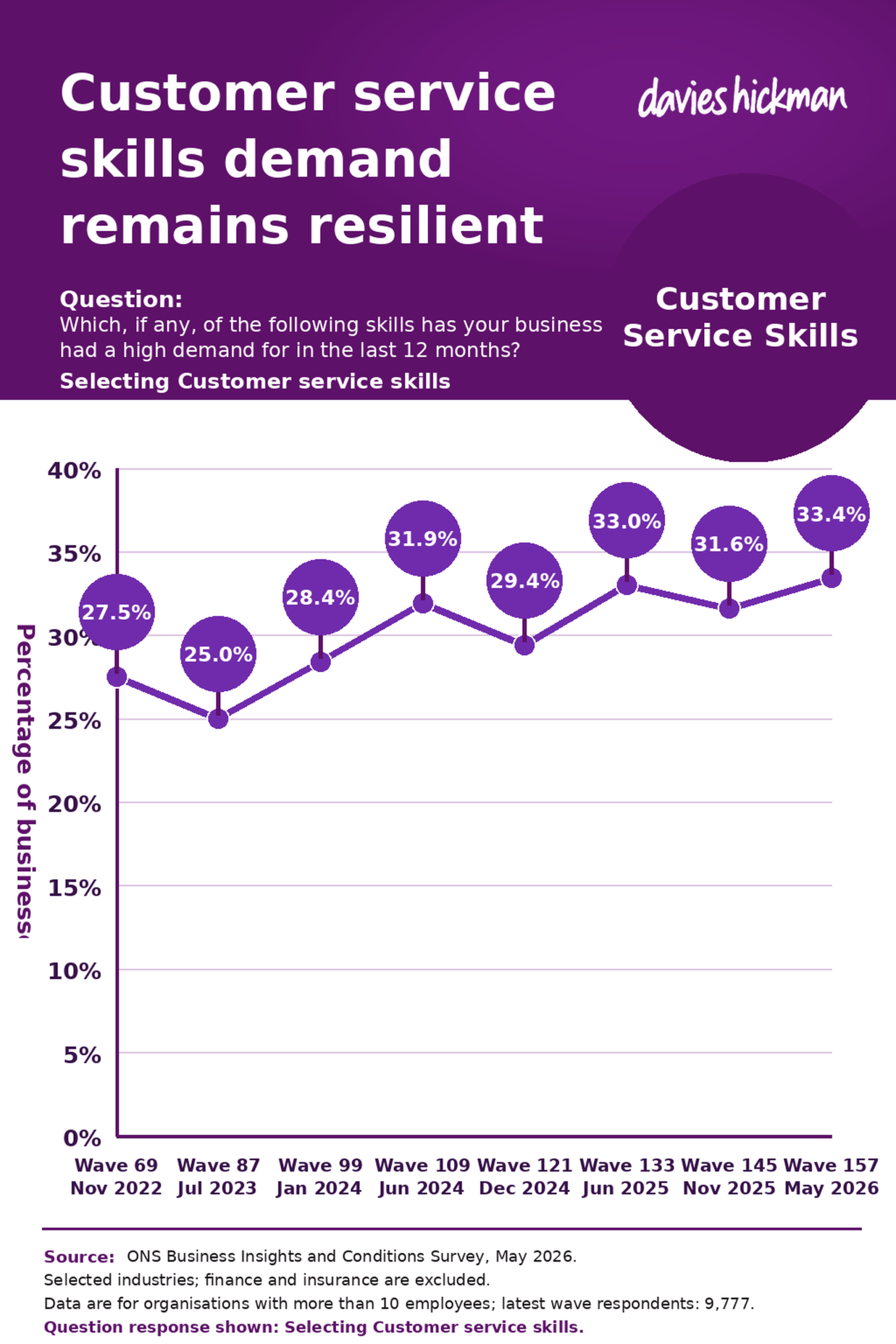
Using the highlighted ONS BICS data in the chart above, we looked at demand for customer service skills over time. In response to the question Which, if any, of the following skills has your business had a high demand for in the last 12 months? the data does not show a collapse in demand for customer service skills.
High demand levels for customer service skills have moved up and down slightly across the waves but it remains at the 1 in 3 level for businesses in the ONS survey.
Almost as importantly, 31.2% of businesses expect to have high demand for customer service skills in the next 12 months.
This suggests that, even with growing AI adoption, UK businesses are not yet reporting a dramatic fall in demand for customer service labour skills.
This does not mean AI is having no impact. It may mean that the impact is still emerging or that AI is changing the nature of customer service work rather than removing the need for it altogether.
Digital skill are more in demand
The second chart looks at demand for advanced digital skills over the same period.
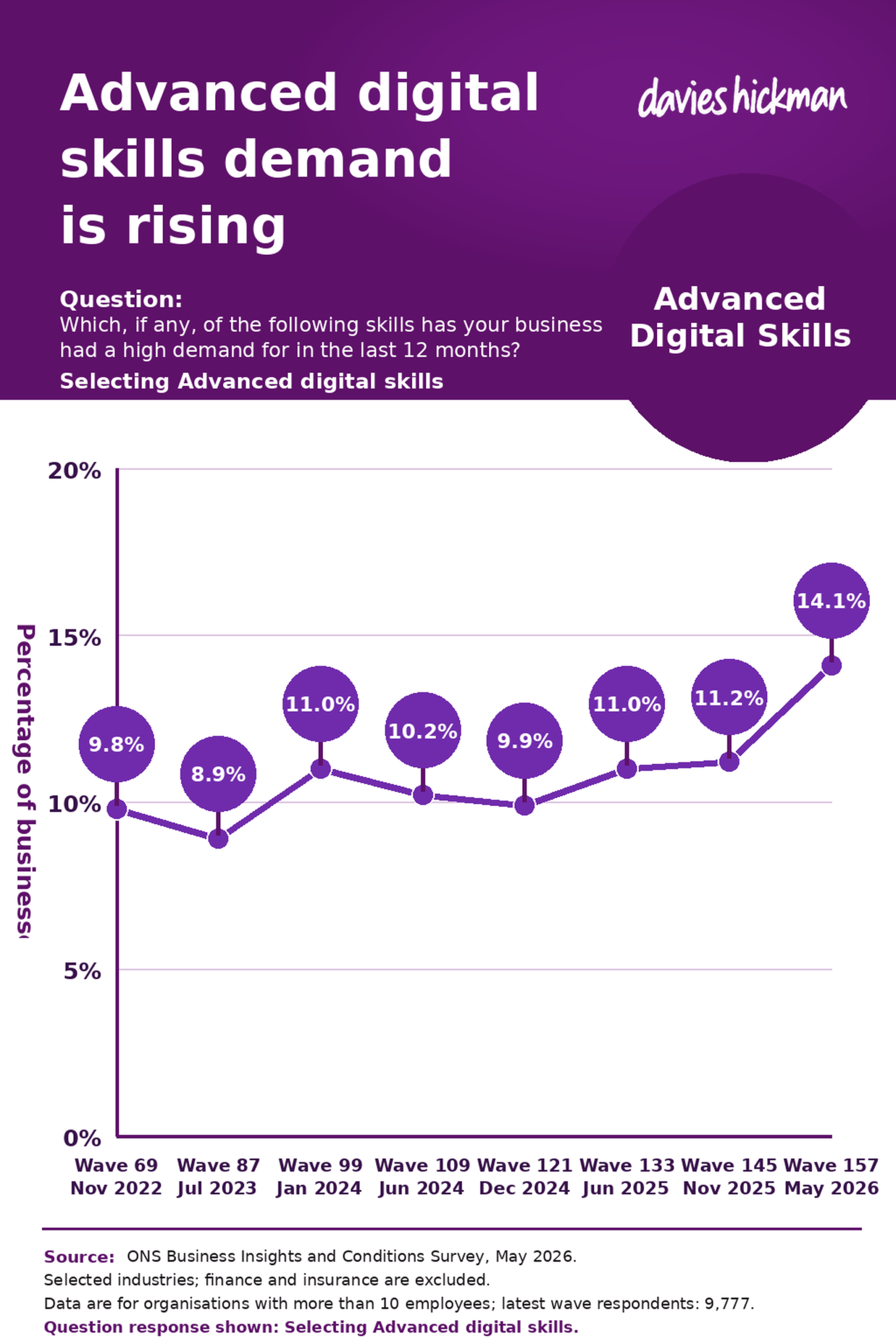
Here, the trend is different. Demand for advanced digital skills has increased, especially in the latest wave of the ONS’s research. Although the survey does not define what it means by “advanced digital skills”, the increase suggests that businesses are placing greater importance on more specialised digital capabilities. This may include skills needed to adopt and manage AI, although the data does not confirm that directly. Rather than simply removing customer-facing roles, GenAI may be pushing businesses towards a different type of customer service workforce. Routine contacts may increasingly be handled by AI, while people may be needed for escalation, quality control, empathy, complex problem-solving and managing AI-supported systems.
So where does this leave us?
The strongest conclusion is that the predicted disruption has not yet appeared in the UK business skills demand data.
There are sreasons to believe customer service roles will be affected by GenAI. Analysts are predicting significant job losses, customer service roles appear near the top of AI exposure lists, and companies such as Klarna show that AI can already handle large volumes of customer conversations.
But this transition may take longer than predicted. Fewer customer service jobs may be affected as businesses use AI to improve their levels of customer service. As we all know, GenAI tends not to produce identical responses to the same prompt from different people; this may challenge compliance requirements in large organisations.
The likely story is that customer service work changes. AI may take over more routine tasks, while human customer service roles become more focused on judgement, empathy, escalation and managing more complex customer relationships.
The jobs losses may still come. But so far, this data suggests we are not seeing this at scale just yet.